
VOLUME 01 ISLAND INSIGHT • CHAPTER 02
The Story of the Yellow Bridge
How One Narrow Crossing Became Vital to Life on Nusa Lembongan and Ceningan
- August 10, 2026
- 8 Minutes Read
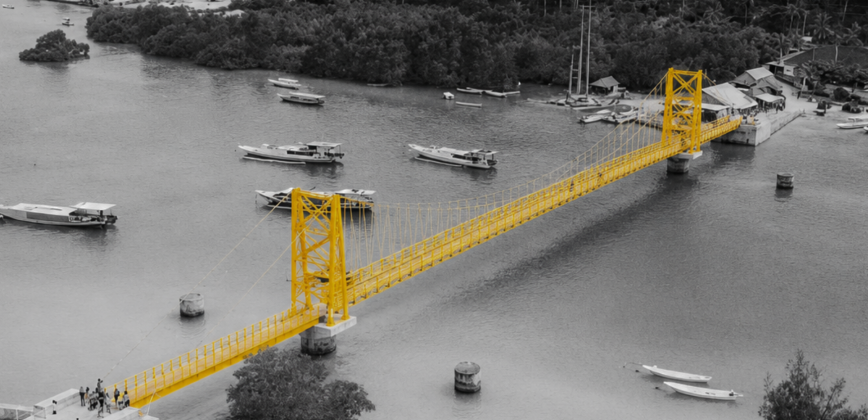
The Yellow Bridge is more than a landmark between Nusa Lembongan and Ceningan. It carries the daily movement of students, workers, families and supplies, allowing two small islands to function as one community.
Before there was a bridge
The channel between Nusa Lembongan and Ceningan is narrow, but before a permanent crossing existed, every journey still required a boat.
Movement depended more heavily on tide, weather and the availability of someone to make the crossing. Even a short trip between the islands required more planning than it does today.
This affected ordinary routines. People crossed for family, ceremonies, trade and work. Goods moved between landing points. Farmers and fishermen worked around the channel, and children travelling for school followed the same conditions as everyone else.
The two islands were already closely connected, but the water remained a physical boundary between them.
That began to change when the first bridge was built in the mid-1990s. Official records use approximately 1995, while several secondary accounts use 1996, so the exact year should still be confirmed locally before publication.
When crossing became part of daily life
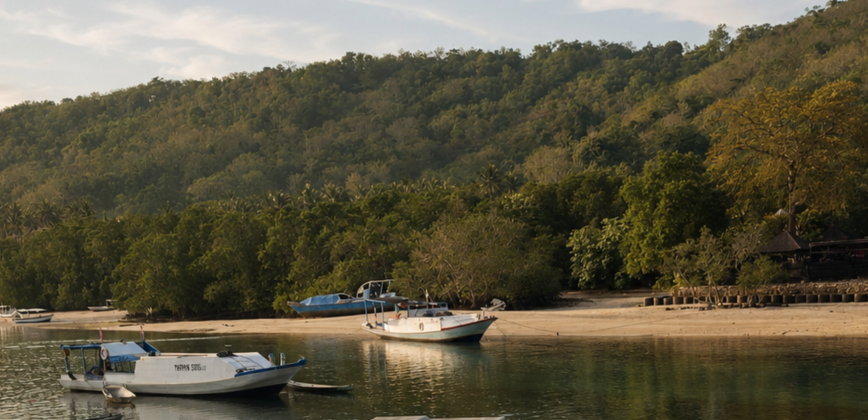
The first bridge created something that is easy to take for granted today: a direct route between the islands.
Instead of arranging a boat, residents could cross on foot. Motorcycles became part of the daily traffic, allowing people to carry more and travel further once they reached the other side.
Someone could live on one island and work on the other. Students could travel to school more easily. Families could attend ceremonies and community activities without organising a sea crossing. Small businesses could reach workers, customers and supplies from both sides of the channel.
As tourism developed, the crossing became more important. Accommodation and restaurants opened on Nusa Ceningan, while visitors arriving through Nusa Lembongan could continue across by motorcycle or on foot. The bridge did not create every connection, but it made those connections faster and more dependable.
The day the bridge was lost
On Oct 16, 2016, the original Yellow Bridge collapsed while residents were crossing towards Nusa Ceningan for a religious ceremony at Pura Bakung. Eight people died and 34 were injured. This part of the bridge’s history must be told with care. It was not simply an infrastructure failure or an interruption to tourism. It was a tragedy experienced by local families and the wider island community.
The collapse also removed the only direct land crossing between Nusa Lembongan and Ceningan. Workers, students, residents and motorcycles had to use sampan again. Around 100 students from Nusa Ceningan who attended school on Nusa Lembongan needed to leave earlier and remove their shoes before boarding so they would not arrive wet.
A journey of only a few minutes became dependent once more on boats, waves and tide. The disruption revealed how much island life had grown around a single crossing.
Rebuilding the connection
Work on the replacement began soon after the collapse. The new Yellow Bridge was completed in early 2017 and formally returned to community use following a Balinese purification and inauguration ceremony on Feb 25, 2017. The replacement retained the familiar suspended form but was widened from approximately 1.6 metres to 1.8 metres. It was designed for pedestrians and motorcycles, the same kinds of daily movement that continue to define the crossing.
Its return restored more than convenience. Students could reach school without boarding a boat. Workers returned to regular routes. Businesses on Nusa Ceningan reconnected with the larger flow of people and services through Nusa Lembongan. Families could move between the islands without planning around a water crossing.
The route to work, fuel and essential services
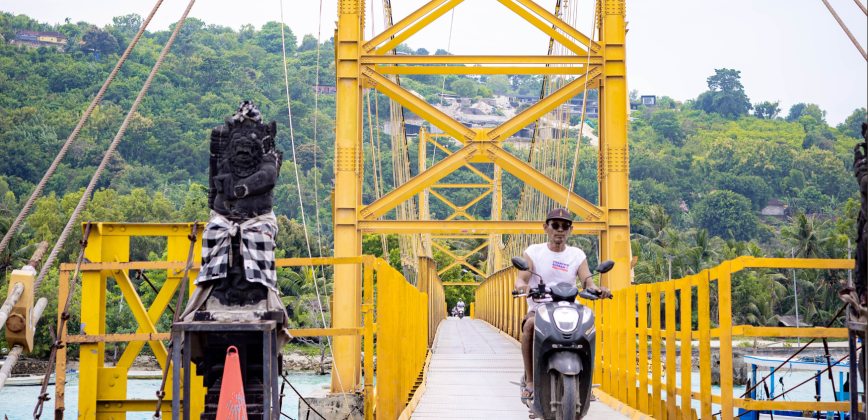
The Yellow Bridge supports many journeys that rarely appear in tourism photographs. Employees cross to hotels, restaurants, transport businesses and construction sites. Residents travel for school, family responsibilities and ceremonies. Motorcycles carry food, tools and smaller supplies between the islands.
Nusa Ceningan is also home to the SPBU Kompak fuel station opened in 2019. It was established to give island communities more dependable access to fuel without requiring people to purchase it from mainland Klungkung or Nusa Penida at greater cost. For residents and workers travelling from Nusa Lembongan, the bridge forms part of that access.
Nusa Ceningan’s coastal landing and harbour activity also supports the movement of fuel, goods and passengers. The bridge connects these services with roads, workers and businesses on both islands.
It cannot carry everything. Cars, large equipment and heavy construction materials still require sea transport. The bridge and local boat network therefore work together rather than replacing one another. When one part of this movement is interrupted, the effect travels quickly through both islands.
More than a crossing
Over time, the Yellow Bridge became one of the most photographed places on the islands. Its colour, narrow structure and position above the channel make it immediately recognisable.
But for someone who crosses every day, the bridge is not primarily an attraction. It is the way to work, the school route and the connection to family, fuel, supplies and community responsibilities. It can be an island landmark and essential public infrastructure at the same time.
On a small island, infrastructure does not need to be large to carry a major responsibility. When the bridge functions, thousands of journeys feel ordinary. When it closes, there is no simple road detour. The alternative is the sea.
The Yellow Bridge has carried school journeys, working days, ceremonies, fuel runs, family visits and visitors discovering Nusa Ceningan for the first time. It is more than the point where Nusa Lembongan ends and Nusa Ceningan begins. It is where the two islands meet and continue their story together.