
VOLUME 03 ISLAND VOICE • CHAPTER 03
Keeping the Island Supplied: Basir and Segara Dwi Putra
Through a family boat business, Damara, better known as Basir, carries everyday goods between Bali and Nusa Lembongan while navigating weather, risk and responsibility.
- August 10, 2026
- 7 Minutes Read
Damara, better known as Basir, was born and raised on the islands. The sea was never simply a view from home. It was family history, work, risk and the route through which daily life remained connected to Bali. Through Segara Dwi Putra, he continues a boat business carried from his grandfather to his father and then to him.
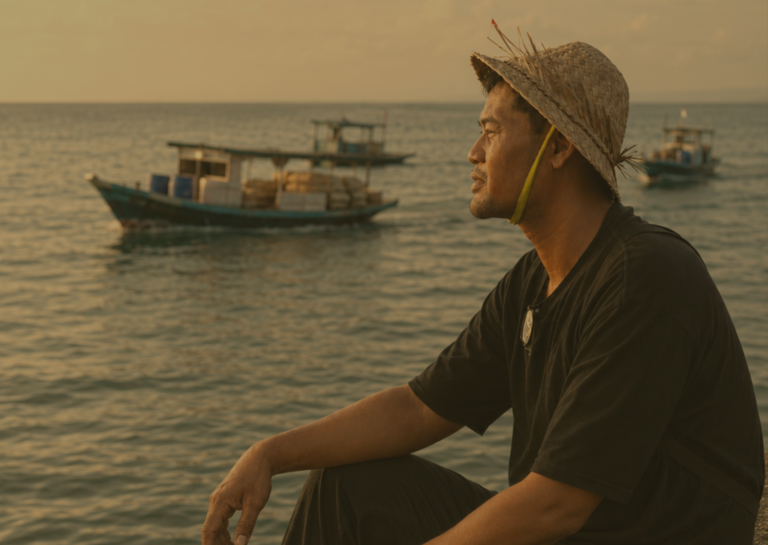
A family business on the water
Boat work runs through Basir’s family. His grandfather and father both worked in trade and sea transport. After his father died while Basir was still young, he learned by working on other people’s boats before moving into ownership himself.
For Basir, the boat is inseparable from livelihood. Without a vessel, he explains, the work inherited from his family cannot continue. The boat carries far more than cargo: it supports a household’s ability to earn, serve customers and keep working across the sea.
The supply line most visitors do not see
Today, Basir says his main operation focuses on sembako, meaning food and basic daily necessities, for local residents. Earlier, he also carried construction materials and at one point operated three boats, including two used for material transport. His work sits inside the supply line connecting Bali with Nusa Lembongan.
A restaurant can serve lunch because ingredients arrived. A family can restock a shop because basic goods crossed the water. The final customer may never know the operator who carried them, but daily island life depends on the loading, timing and crossing behind every delivery.
Risk travels with every load
Sea transport combines physical risk with business risk. Weather and water conditions are visible. Payment, coordination and responsibility can be harder to read. Basir’s interview describes how two boats used for construction materials became unsustainable after payment arrangements failed through intermediaries.
The lesson is not only personal. Island supply chains rely heavily on relationships and clear payment responsibility. When an agreement breaks, the effect moves quickly from the boat owner to crew, suppliers, customers and the wider project. Local operators can carry substantial risk long before a final customer sees the result.
An island growing brighter
Basir has watched tourism change the islands since childhood. More accommodation brought more work, more light and a stronger local economy. It also changed the quiet character he values. In his interview, noise is one of the clearest concerns he associates with growth.
He does not describe growth as simply good or bad. His concern is how people behave inside it. New investors and operators enter a place with existing families, customs and working relationships. Respect, honest agreements and fair treatment are part of whether a business can belong here.
What responsible investment sounds like locally
From Basir’s perspective, responsible investment begins with conduct. It means treating local people properly, making responsibilities clear and not assuming that money removes the need for trust.
This advice comes from repeated experience. Local boat operators see projects at their most practical stage. They move goods, solve delays and absorb the consequences of unclear decisions. Listening to them can reveal risks and dependencies that remain invisible in a presentation.
A future with more than tourism
Basir hopes seaweed farming and other local livelihoods can remain part of the islands’ future. He also speaks about better education and stronger local capability. An island economy becomes more resilient when people have several ways to work, learn, own and lead.
Transport will remain essential because the islands cannot operate without connection. The larger question is what development brings back: only more demand, or also fair opportunity, knowledge and stronger local capability.
Why this Island Voice matters
For an investor or project owner, Basir’s story is a close view of the island supply chain. It shows why cargo type, weather, payment terms, trusted coordination and the capacity of local operators belong in practical planning.
For local operators, Island Voice recognises work that often stays invisible until goods fail to arrive. Basir is not background to island development. His knowledge, equipment and relationships are part of the infrastructure that makes daily life and business possible.
The purpose is not to advertise a boat or publish a direct contact. It is to show the person, risk, knowledge and contribution behind a system the island depends on. Every crossing carries supplies, but it also carries continuity.